
Arts & Crafts Farmhouse, Hampshire
What was the project brief?
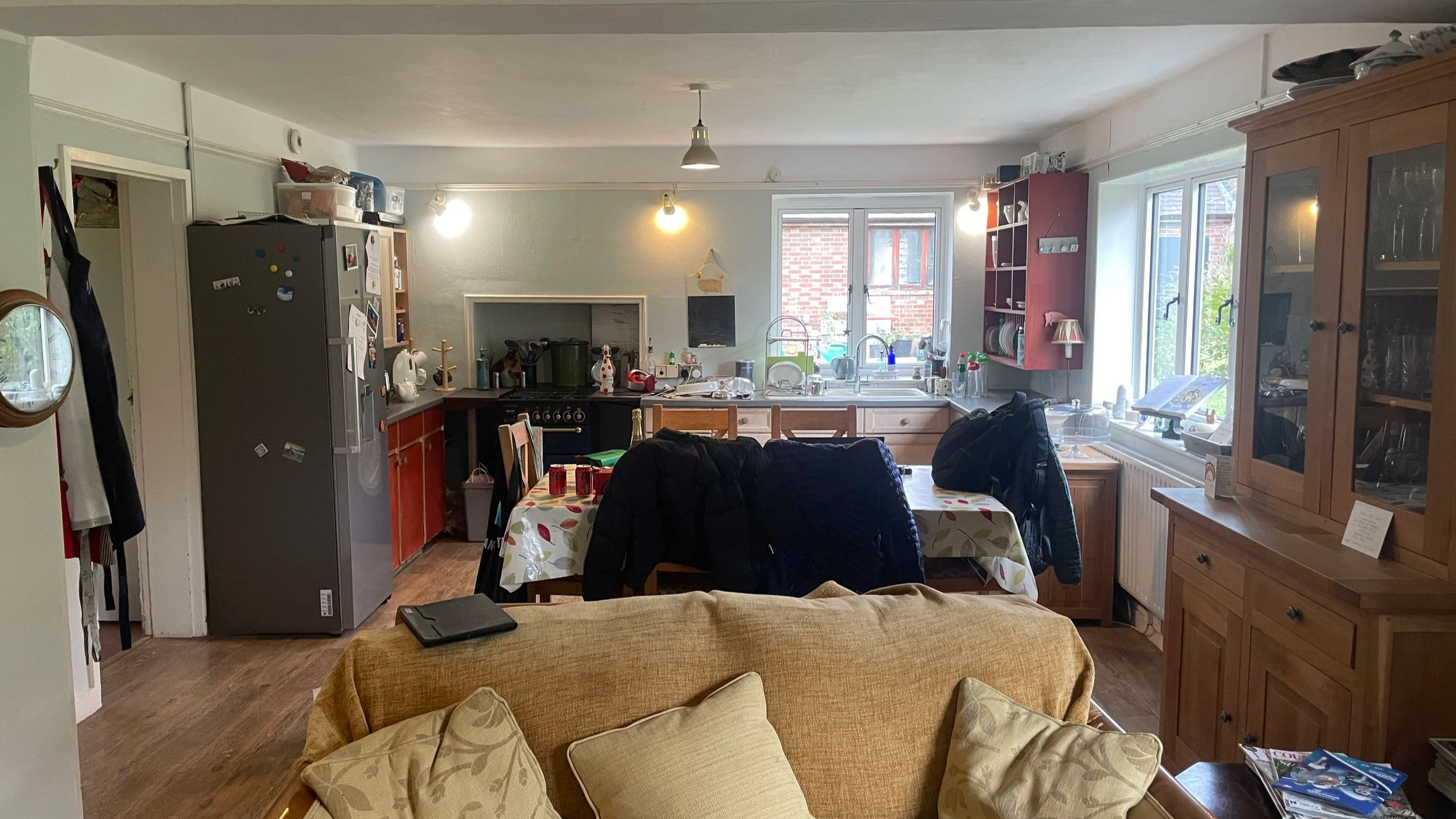
This project involved the design and manufacture of a bespoke kitchen for a detached Arts and Crafts–era farmhouse located in rural Hampshire, completed in August 2025. The client approached Daulby and Tickle with a clear aspiration: to create her dream kitchen inspired by the contemporary aesthetic of Bulthaup, a style she had admired for many years.
However, the client had received conflicting advice from friends and acquaintances who felt that the traditional character of the farmhouse demanded a classic in-frame or farmhouse-style kitchen. Many believed that introducing a contemporary scheme would feel inappropriate within the architecture of the property. Despite this, the client remained committed to achieving a modern and refined aesthetic.
Prior to contacting Daulby and Tickle, the client had commissioned a design from a Bulthaup dealer. While the proposal reflected the brand’s visual language, it failed to maximise the potential of the space, leaving the client dissatisfied with both the layout and functionality.
Following an on-site consultation, detailed measurements were taken and a full design brief established. The primary focus was the kitchen and adjoining utility/laundry room, with the project later expanding to include a boot room and bar area. The brief itself was intentionally open, allowing Daulby and Tickle significant creative freedom to reinterpret the space while responding to the character of the property.
Key constraints included the age and proportions of the building, a relatively compact kitchen area, an oversized utility room, and a large chimney breast housing an existing range cooker.
How did the project meet the brief?
The primary challenge of the project was to reconcile the client’s desire for a contemporary kitchen with the character and constraints of an Arts and Crafts–era farmhouse. The available kitchen space was relatively compact, and an early review of the layout revealed that the room could not comfortably accommodate a well-proportioned island, a key feature the client considered essential to her vision of a dream kitchen.
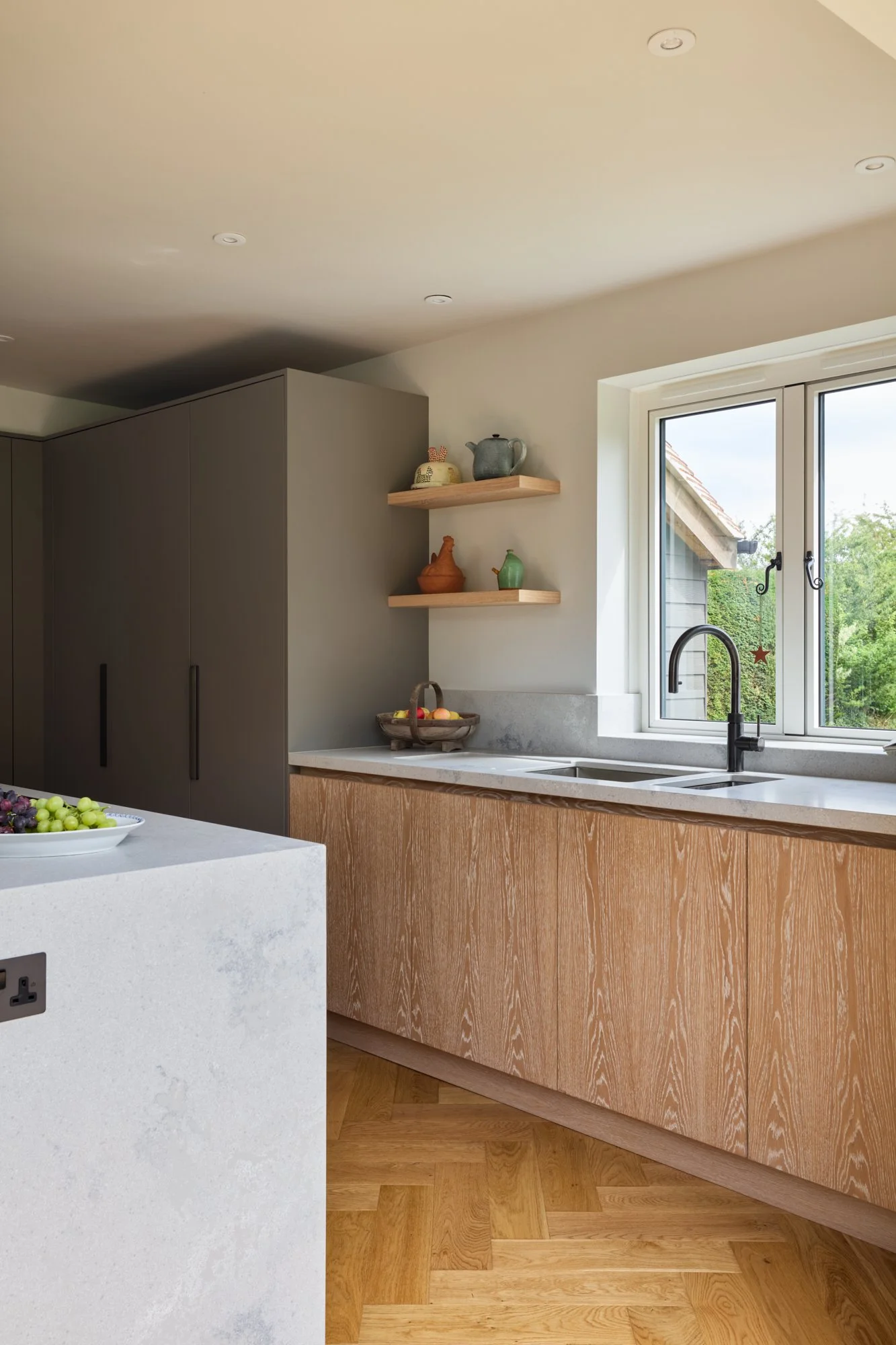
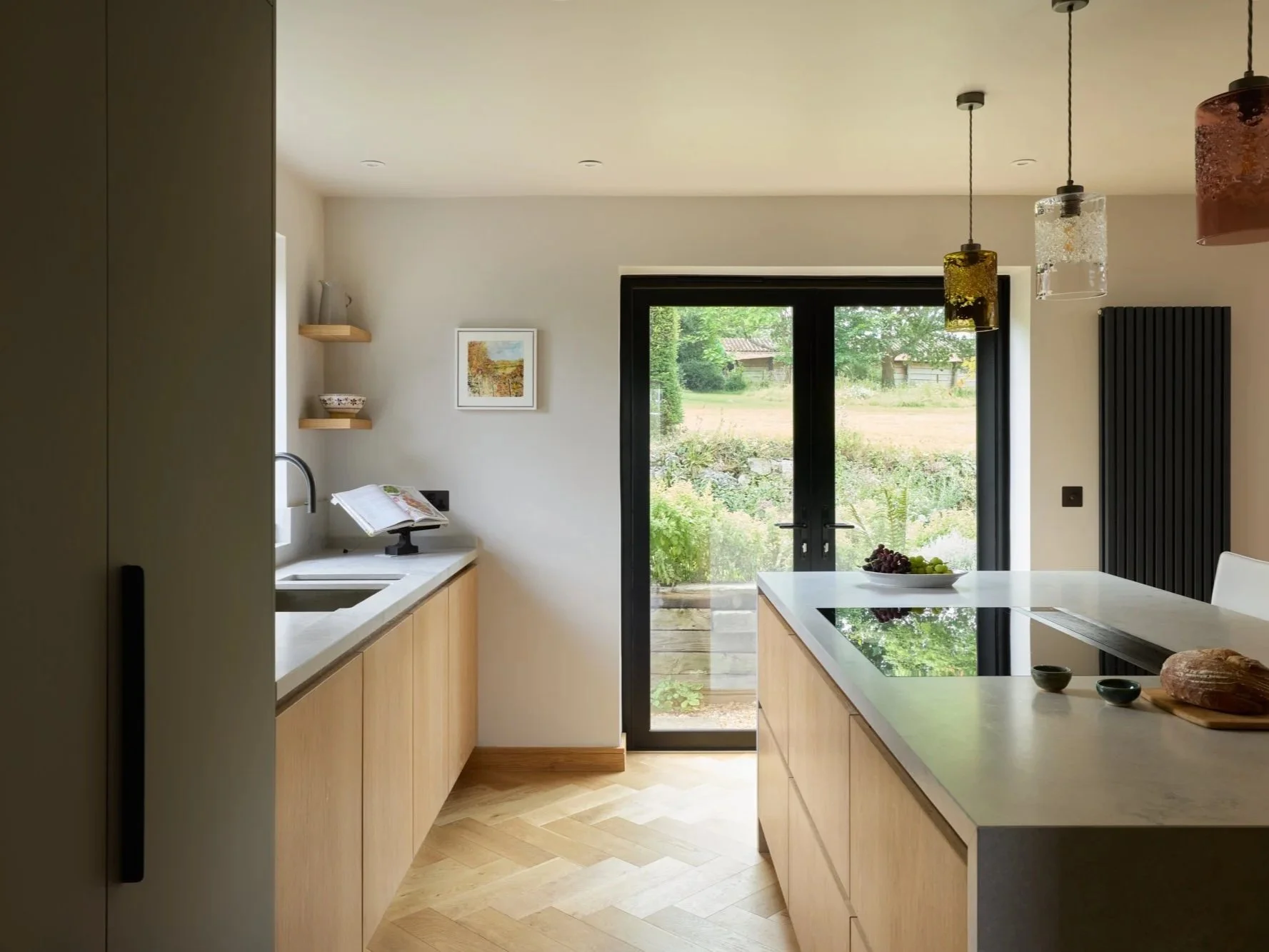
We began by carefully analysing the proportions of the adjoining rooms. The utility room was significantly larger than required, while the kitchen lacked sufficient circulation space. By removing the dividing wall and extending the kitchen footprint into part of the utility room, the usable width of the kitchen increased by approximately 600–700mm. This adjustment allowed the introduction of a properly scaled island measuring approximately 2.3 metres in length, transforming both the functionality and visual balance of the space.
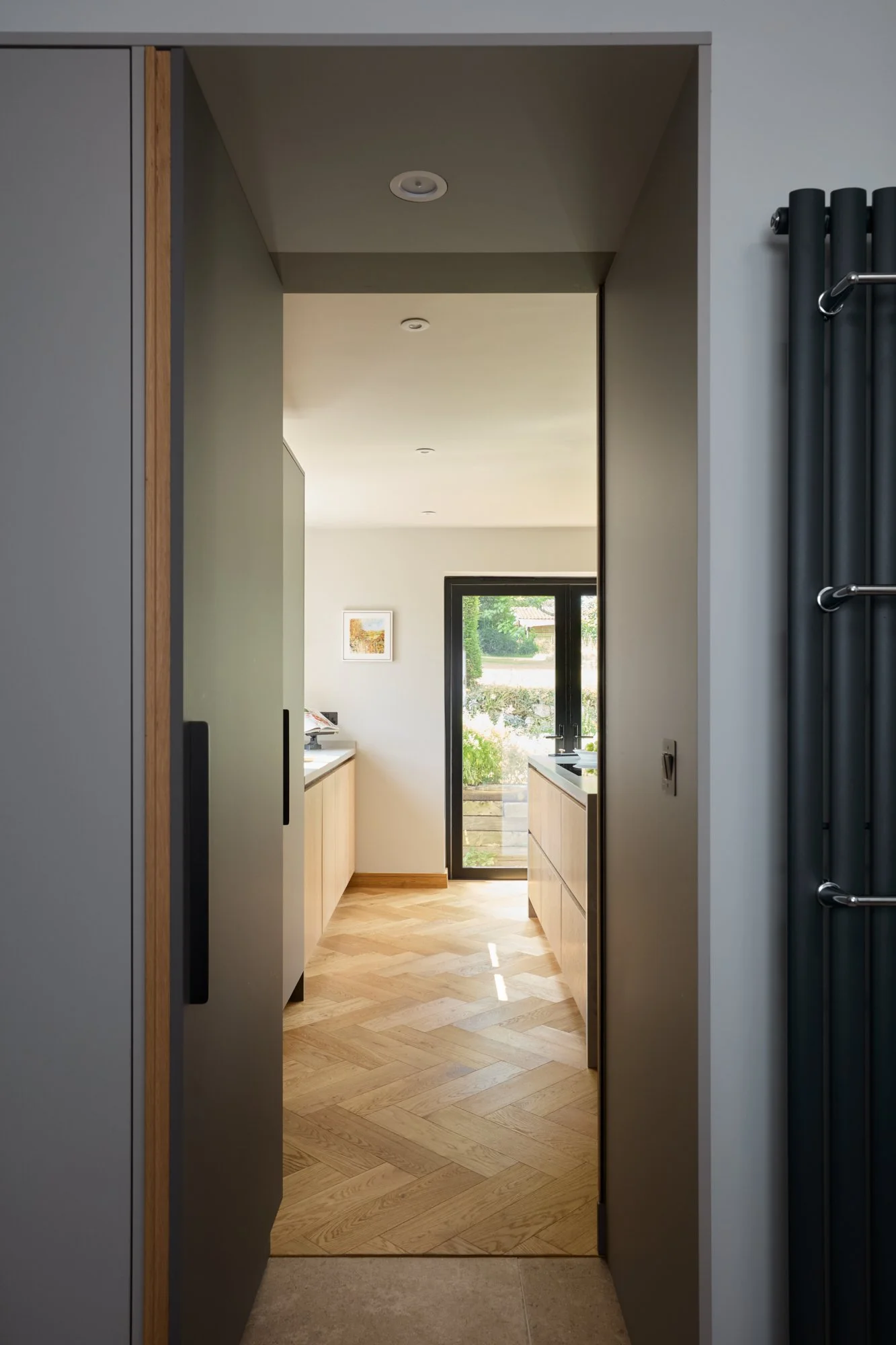
To maintain a practical separation between the two areas while preserving the newly optimised layout, a new stud wall and built-in cabinetry were introduced within the utility room. This ensured the utility remained generous and highly functional, while allowing the kitchen cabinetry to appear seamlessly integrated into the architecture.
A distinctive feature of the design was the introduction of a concealed transition between the two spaces. Rather than using a conventional doorway, Daulby and Tickle designed a hidden door that sits flush within the kitchen cabinetry. Detailed with a continuous plinth line and matching fronts, the door reads visually as another cabinet panel. When opened, it swings outward from the kitchen to reveal a comfortably sized passageway of approximately 700–750mm, allowing practical movement between rooms even when carrying laundry or household items. This playful yet highly functional design gesture adds an element of surprise while preserving the clean architectural language of the kitchen.
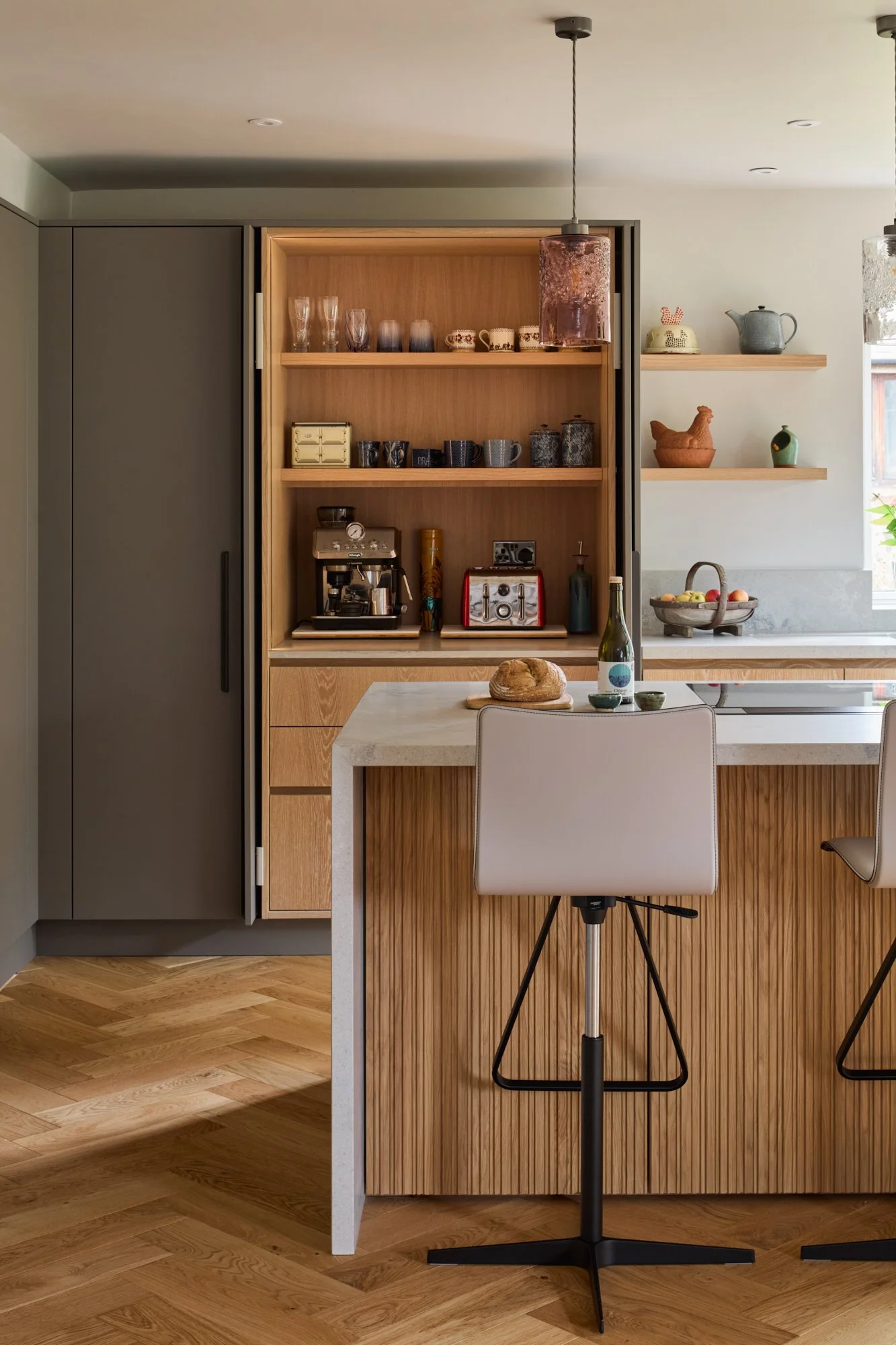
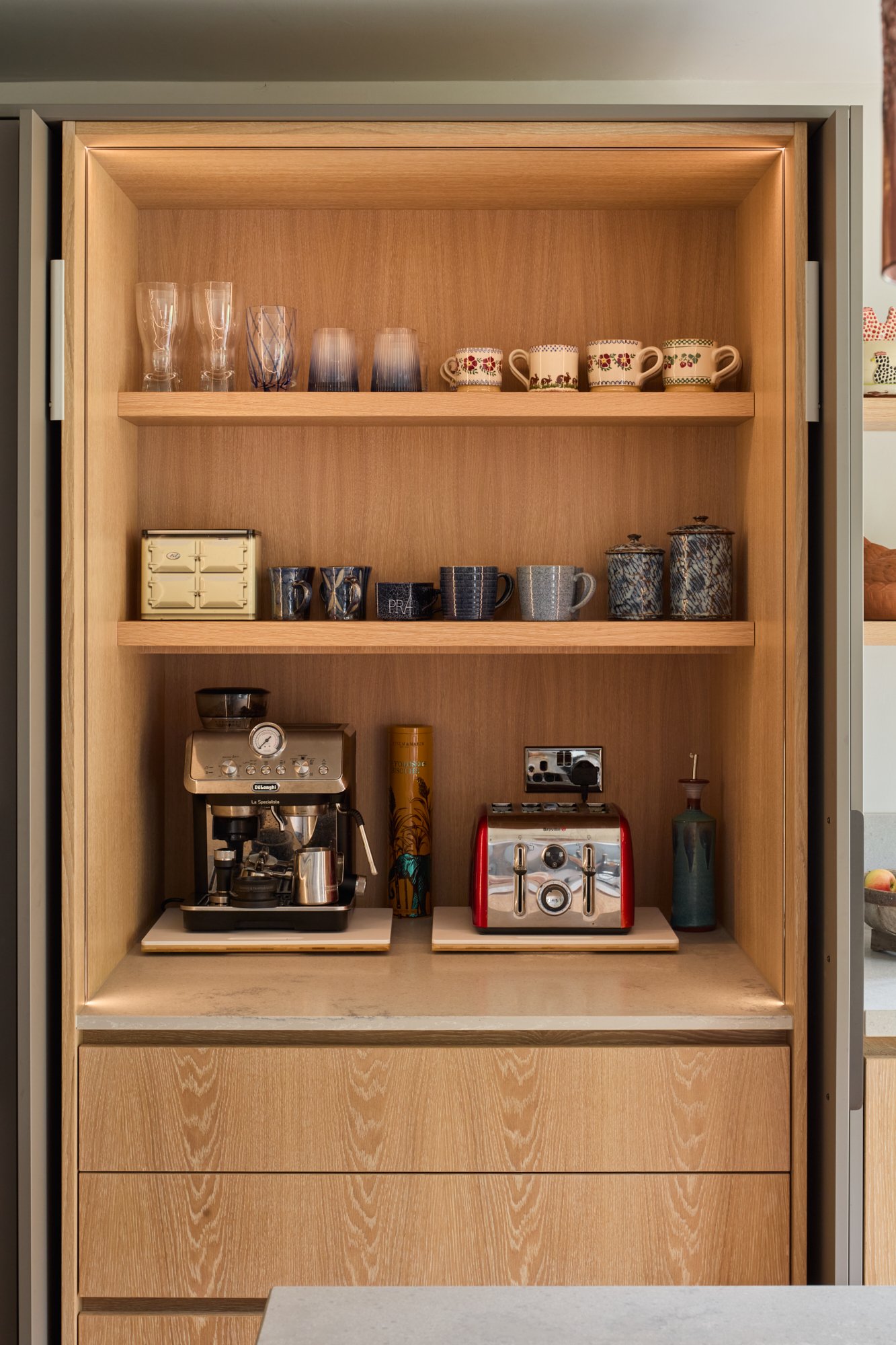
The existing chimney breast presented another spatial challenge due to its unusual proportions. Rather than treating it as an obstruction, it was incorporated into the design as a dedicated pantry and coffee station concealed behind pocket doors. The internal work surface was extended to approximately 900mm depth, utilising the recess within the chimney structure, while shelving above returned to a more conventional depth aligned with the original mantle line. This approach transformed an awkward architectural feature into a highly practical storage and preparation zone.
Material selection played a key role in balancing contemporary design with the heritage setting. FENIX fronts were specified in the colour Grigio Londra, chosen for their ultra-matte surface and tactile quality reminiscent of high-end contemporary European kitchens. These were paired with oak veneered fronts finished with a subtly limed effect using Rubio Monocoat White Oil, introducing warmth and texture that resonates with the Arts and Crafts detailing of the house.
Concrete-effect quartz worktops were selected to reinforce the modern aesthetic while avoiding more traditional materials such as marble or granite. This combination created a refined yet grounded palette that complements the architecture without imitating historical styles.
Within the island, a flush-mounted Gaggenau induction hob and integrated glass downdraft system maintain uninterrupted sightlines across the space, while the breakfast bar encourages informal gathering and everyday use.
Through careful spatial planning, bespoke detailing and considered material choices, Daulby and Tickle delivered a kitchen that feels entirely at home within the farmhouse while confidently expressing a contemporary design language. The project significantly improved both functionality and storage capacity while successfully realising the client’s vision for a distinctive and highly personal kitchen.
Were there any additional considerations on this project not addressed in the brief?
One particular design challenge emerged within the chimney alcove that houses the pantry and coffee station. By extending the internal worksurface depth to approximately 900mm, the space provided valuable additional preparation area when the pocket doors were open. However, this increased depth also meant that small appliances such as the coffee machine and toaster would sit further back within the cabinet and would need to be pulled forward during use.
An early concept involved placing the appliances on a drawer-box mechanism that could slide forward when required. This approach was ultimately rejected due to concerns around cleanliness and maintenance, as crumbs and debris could easily accumulate beneath the drawer unit and become difficult to access.
Instead, Daulby and Tickle developed a more refined solution using heavy-duty worktop gliders. These were sourced and then adapted in-house to improve durability and usability. The sliding platform was lined with Corian solid surface, creating a seamless and easy-to-clean base while allowing appliances to glide forward smoothly when needed. This simple but carefully considered detail significantly improved the usability of the space while maintaining a clean aesthetic.
The project also benefited greatly from Daulby and Tickle’s in-house manufacturing capabilities. Ongoing building works — including wall removal and new flooring — meant that final opening dimensions were not confirmed until approximately two weeks prior to installation. Because the cabinetry was produced internally, cabinet heights and proportions could be adjusted at short notice to achieve a precise architectural fit.
High-quality hardware, including Blum LEGRABOX drawer systems, was specified throughout to ensure durability and advanced storage functionality.

Did this project aim to address sustainability?
While sustainability was not an explicit requirement within the client’s original brief, it forms an integral part of Daulby and Tickle’s design and manufacturing philosophy. The project was approached with a strong emphasis on longevity, durability and ease of maintenance, ensuring the kitchen will remain functional and visually refined for many years without the need for premature replacement.
Materials were responsibly sourced and the cabinetry was constructed using methods that prioritise structural integrity, repairability and long-term performance. Particular attention was given to finishes that would age well and allow straightforward restoration if required.
FENIX fronts were specified in place of traditional spray lacquered doors. While visually achieving the same ultra-matte aesthetic, FENIX offers significantly greater durability due to its thermal healing properties, allowing minor scratches to be repaired through heat. This reduces visible wear and extends the life of the cabinetry.
The oak veneered elements were finished using Rubio Monocoat oil. This single-coat finish bonds with the wood fibres and does not build up in layers, meaning that if the veneer is damaged and raw timber exposed, the finish can be reapplied locally to restore the colour without affecting the surrounding surface.
From a manufacturing perspective, sustainability is also embedded within the operations of Daulby and Tickle. Company vehicles are fully electric, and the workshop is powered by an extensive solar panel installation, ensuring that much of the production process and daily operations are effectively carbon neutral.
List products used
Gaggenau – Induction hob and telescopic table ventilation system
Quooker – Flex boiling water tap with PRO3 tank (Gunmetal finish)
Siemens – StudioLine iQ700 appliance suite including single oven, compact steam oven, warming drawer, fully integrated refrigerator, freezer and dishwasher
FENIX – Cabinet fronts in Grigio Londra ultra-matt finish
Rubio Monocoat – White oil finish to oak veneered cabinetry
Blum – LEGRABOX drawer systems and internal hardware
Egger – PerfectSense Matt MFC cabinetry (utility room)
KonigQuartz – Concrete Shell
Corian Glacier White – Solid surface lining to custom appliance glider system
Project Summary
A contemporary bespoke kitchen that rebalances the architecture of an Arts and Crafts farmhouse, combining intelligent spatial planning, concealed detailing and refined material choices to deliver a highly functional and visually seamless living space.