
West London Residence
What was the project brief?
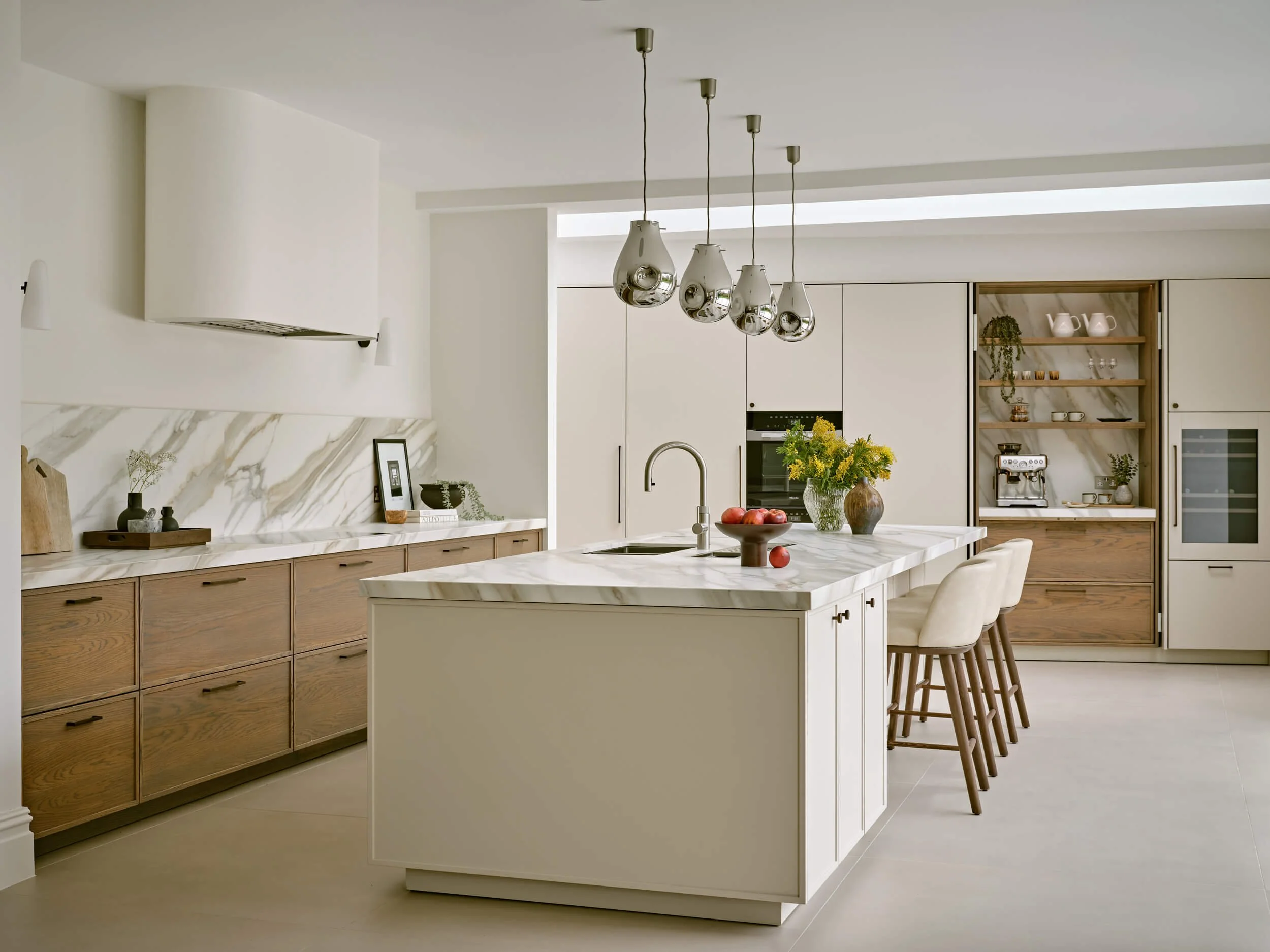
This project involved the design and manufacture of a bespoke kitchen for a detached home in West London undergoing a comprehensive renovation, completed in September 2025. The client was referred to Daulby and Tickle by Pike and Partners Architects, with whom the company maintains a long-standing collaborative relationship. As with many such referrals, Daulby and Tickle were entrusted with developing and delivering the full kitchen design directly with the client.
The client sought a kitchen that would feel distinctly bespoke and handmade, while avoiding the traditional in-frame aesthetic often associated with handcrafted cabinetry. Instead, the aim was to achieve a refined and luxurious finish that retained a sense of craftsmanship without appearing overly traditional or excessively ornate.
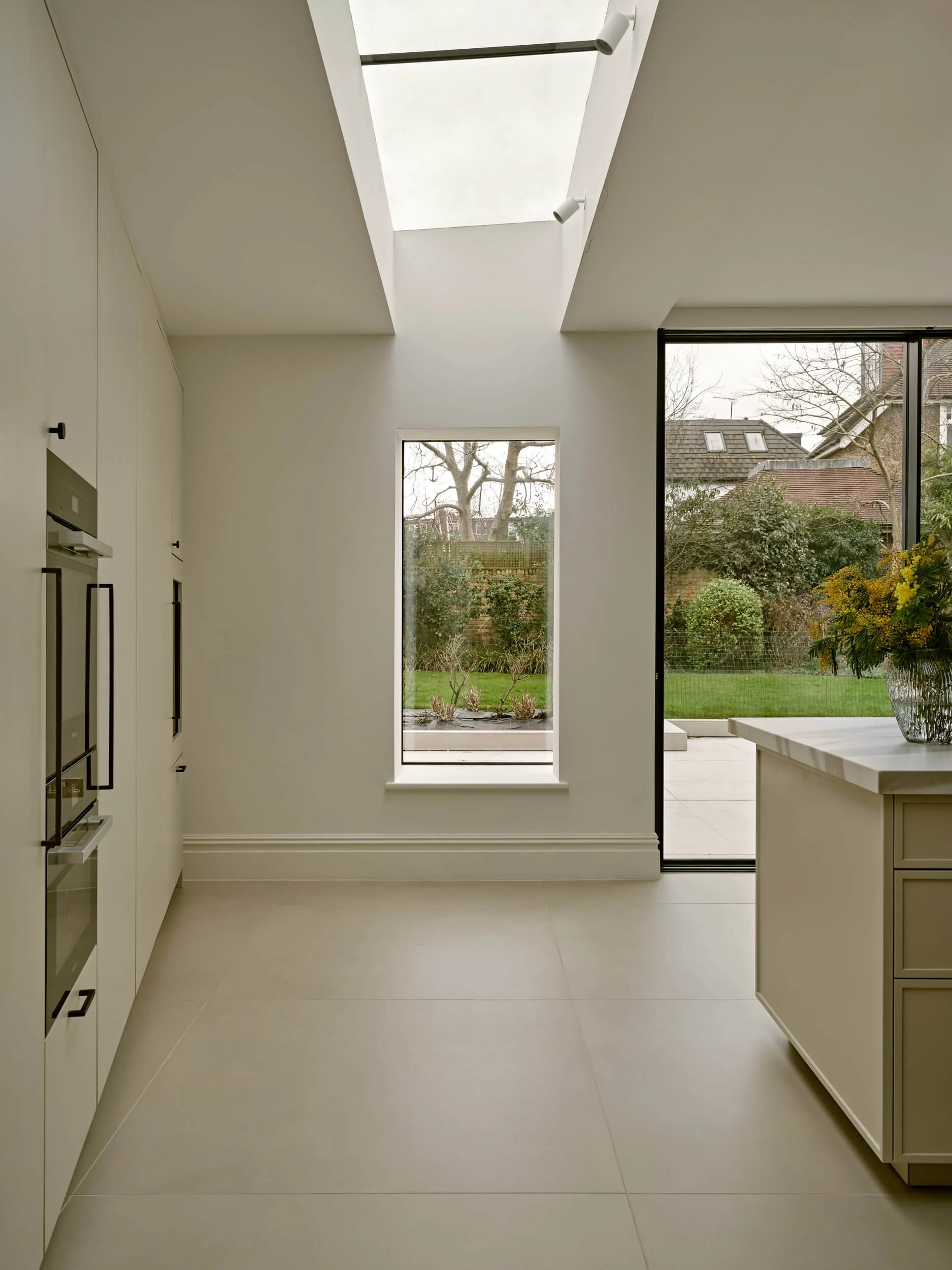
The kitchen formed part of a newly designed rear extension, with the architectural layout providing a strong spatial framework for the project. However, an angled wall within one elevation introduced a design challenge, requiring the cabinetry to integrate seamlessly with the architecture without relying on large filler panels or visible adjustments.
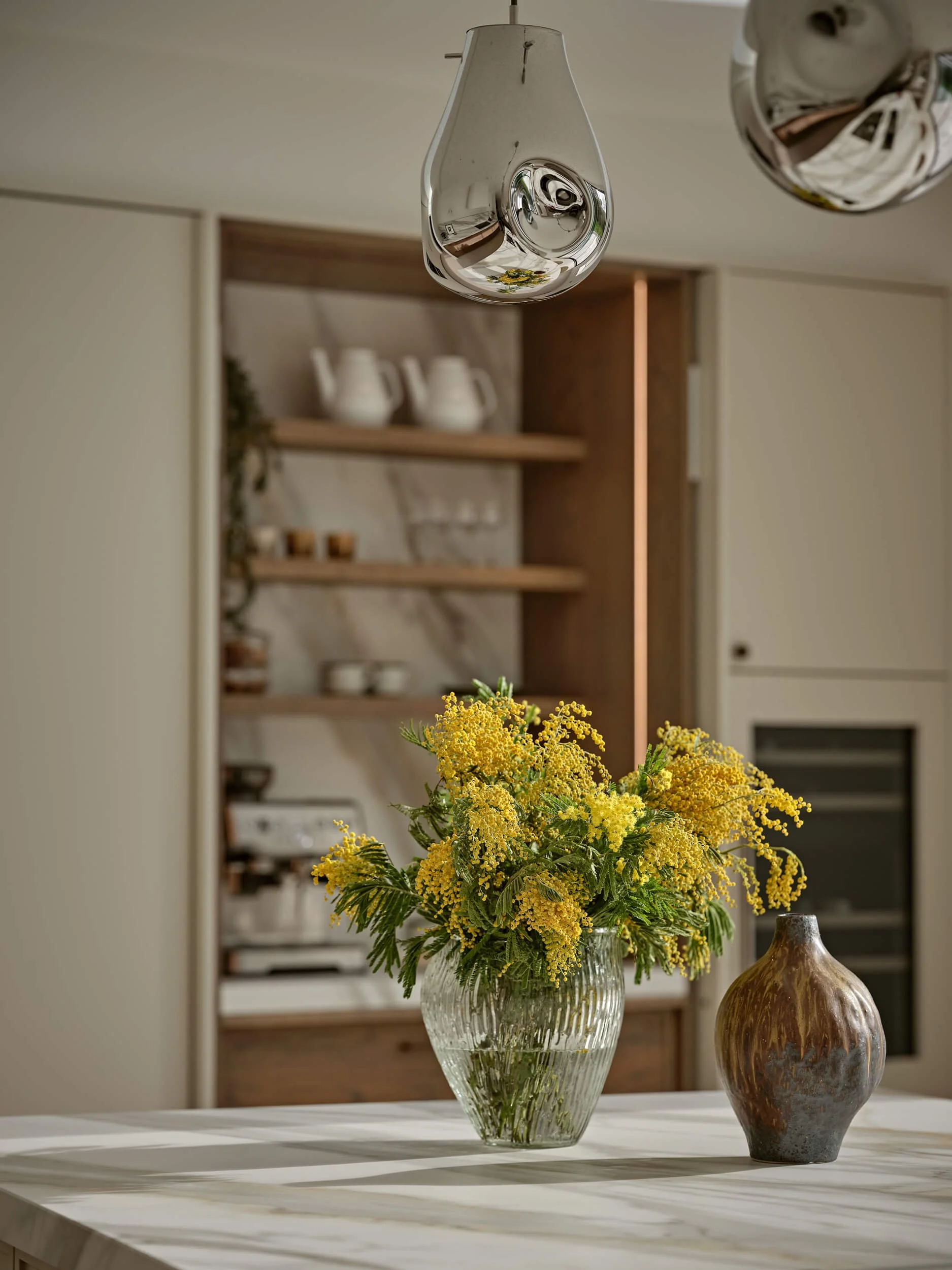
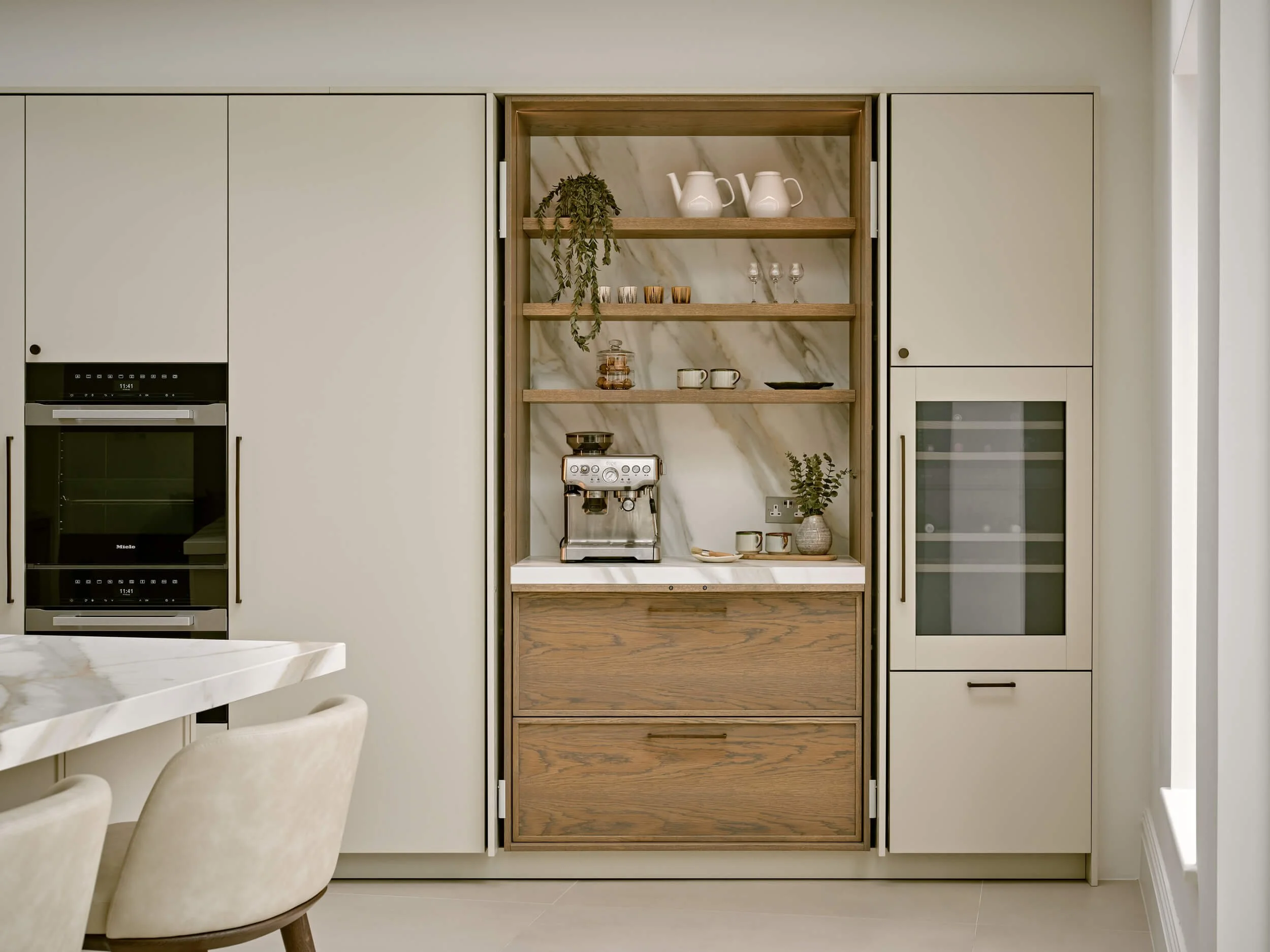
Key elements within the brief included a large island suitable for entertaining, integrated niche storage solutions, a pocket-door breakfast and coffee station, and a high-specification appliance suite centred around a Miele MasterCool refrigerator and Miele cooking appliances.
The client’s interior designer collaborated throughout the design process, contributing to the colour palette and aesthetic direction while Daulby and Tickle led the spatial planning, joinery design and overall kitchen concept.
How did the project meet the brief?
The architectural framework for the project was established by Pike and Partners Architects, whose rear extension created a long and carefully proportioned kitchen space ideally suited to an entertaining-focused layout. Working closely with the client and their interior designer, Daulby and Tickle developed a design that balanced bespoke craftsmanship with a refined contemporary aesthetic, ensuring the kitchen felt handmade without appearing traditionally in-frame.
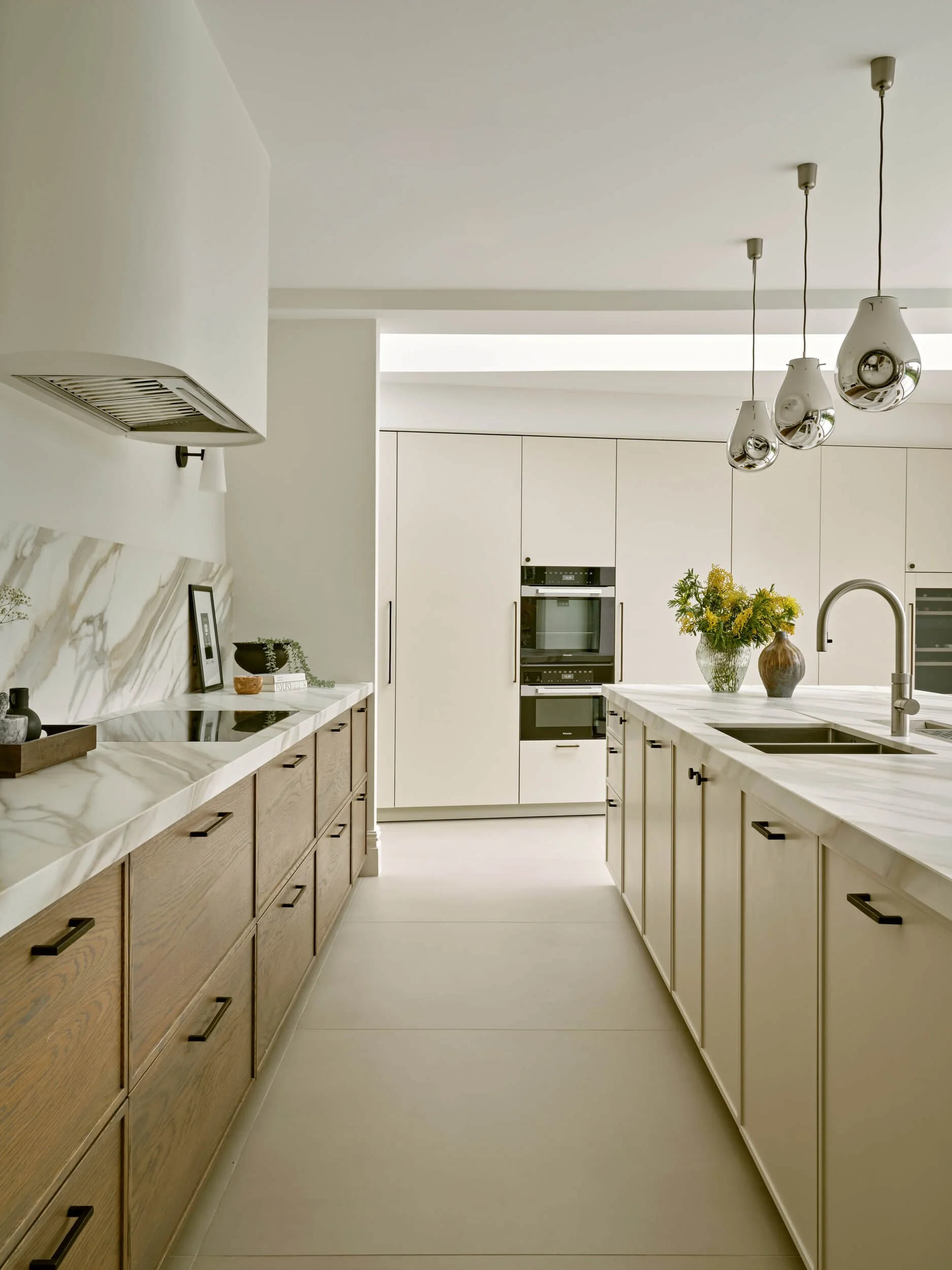
One of the key architectural considerations was an angled wall on one elevation of the room. Rather than relying on large filler panels to accommodate this geometry, Daulby and Tickle reduced the width of the cabinetry and constructed studwork around the units so that the furniture appeared built directly into the architecture. This approach created clean sections of wall on either side of the cabinetry, visually integrating the joinery with the room. The tall cabinets were also intentionally held slightly below the ceiling line by a similar margin, creating balanced proportions that reinforce the architectural composition.
The generous scale of the room allowed for a substantial island measuring approximately 3990mm by 1300mm, which became the focal point of the kitchen. To visually ground the island within the space, a 50mm mitred edge profile was specified for the worksurfaces. This gave the island a sense of architectural weight while maintaining a refined and contemporary aesthetic. Integrated breakfast bar seating further reinforces the island’s role as a social and functional centre of the kitchen.
Material selection played an important role in creating the layered yet cohesive design language requested by the client. On the primary cooking elevation and pocket-door breakfast cabinet, oak veneer cabinetry with a solid oak micro-shaker frame was specified. The frames were carefully proportioned at just 18mm thick, creating a slender but tactile detail that conveys craftsmanship without appearing overly traditional. The oak veneer was sequenced and applied horizontally across the cabinetry rather than the more typical vertical orientation, introducing subtle visual movement across the elevation.
These timber elements were finished using Rubio Monocoat oil, enhancing the natural grain while allowing for simple future maintenance. In contrast, the island cabinetry and secondary tall storage were finished in a painted micro-shaker style using maple and ash veneers respectively. The cabinetry was finished in Little Greene Rolling Fog Light 271, introducing a warm and balanced neutral tone that works harmoniously with the timber elements and surrounding interior scheme.
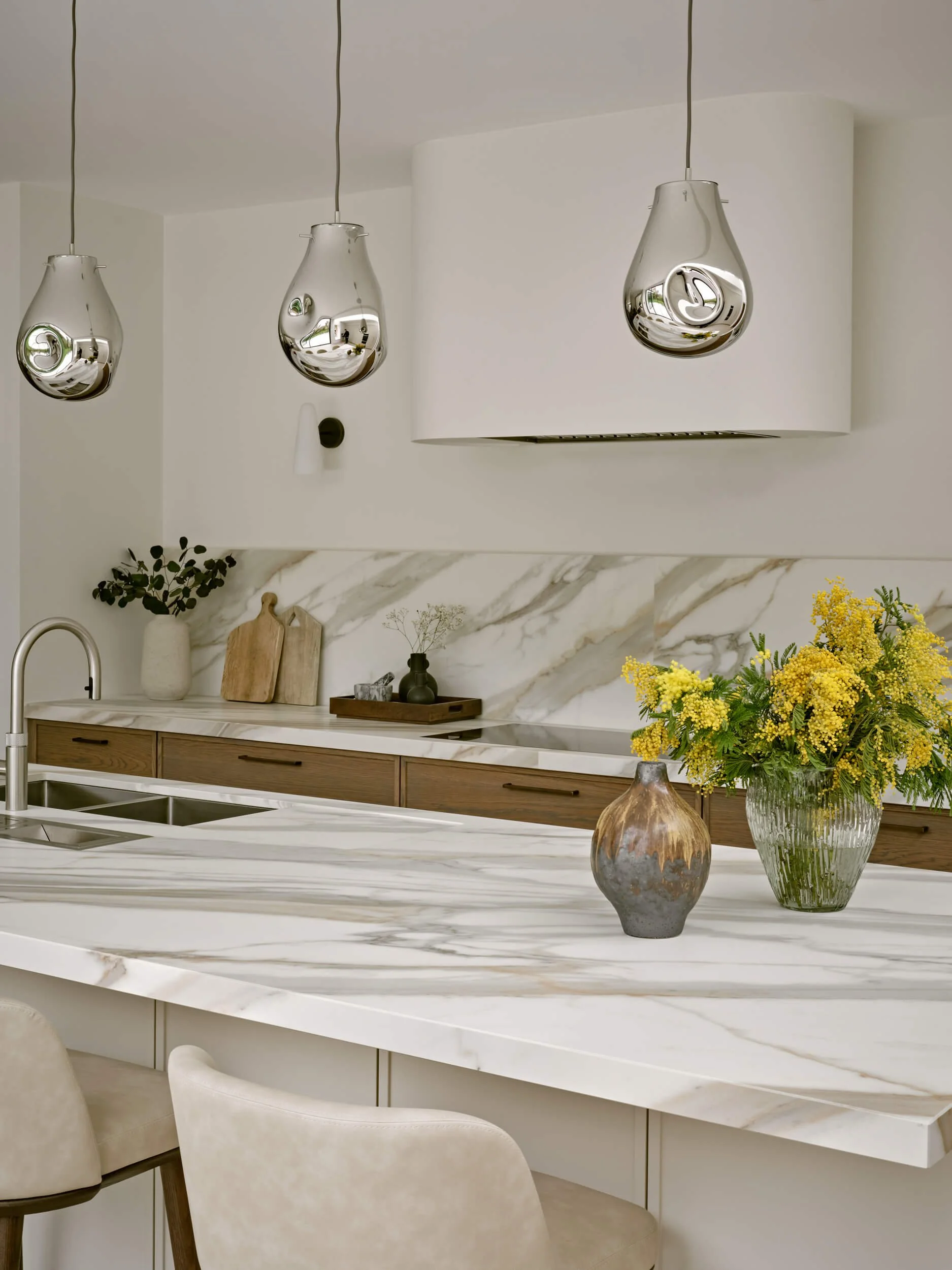
A distinctive design feature within the kitchen is the bespoke rounded chimney structure designed to house the 860mm-wide Westin Bloque extractor. Constructed using formable MDF and painted to match the surrounding wall colour, the feature reads visually as a plaster-built architectural form rather than a conventional extractor canopy, creating a sculptural focal point above the cooking area.
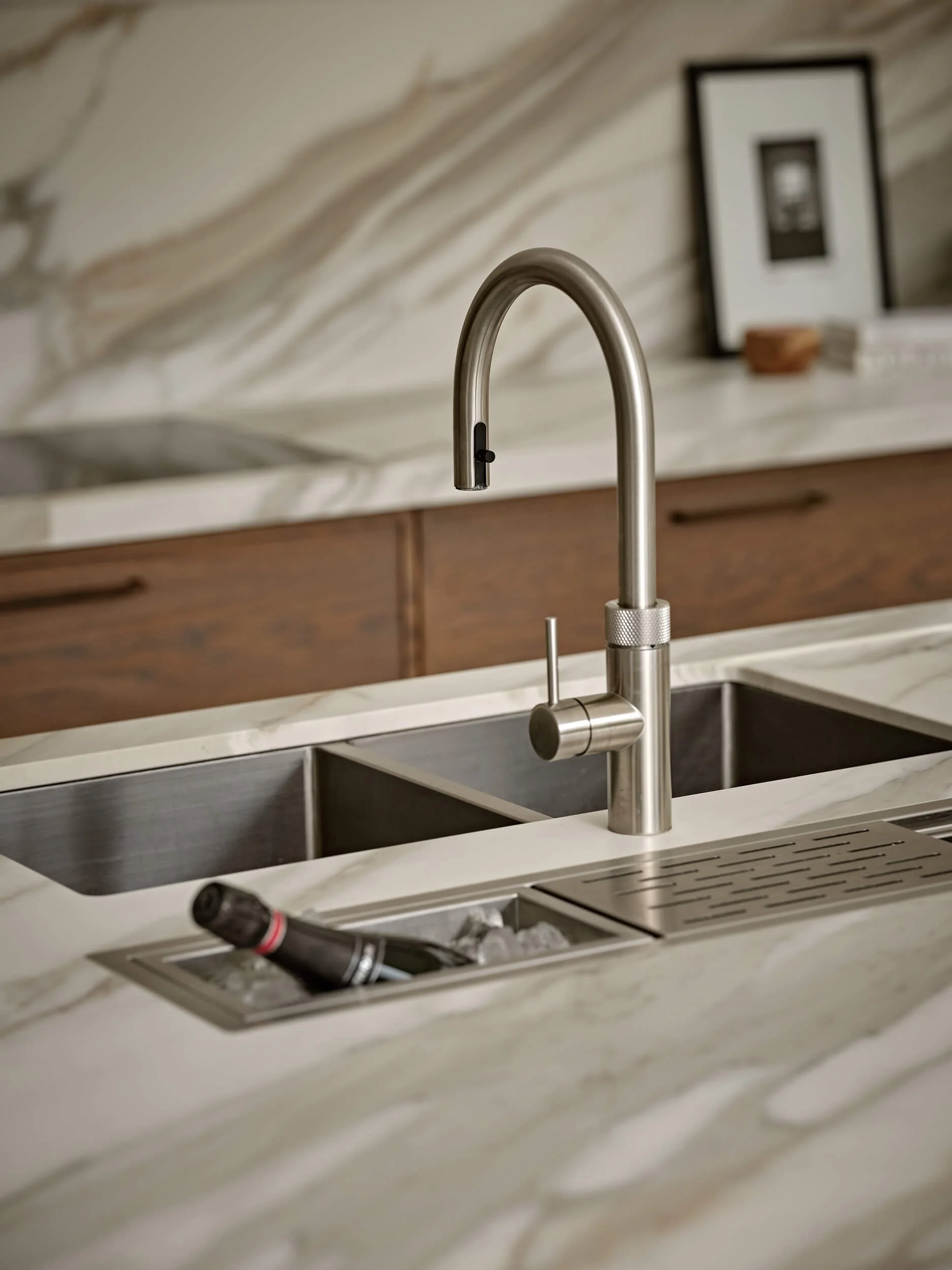
Worksurfaces were ultimately specified in Sapienstone Calacatta Aureo 4D ceramic, used across the island, preparation run, splashback and inside the pocket-door breakfast cabinet. The through-body veining of the material allows features such as drainage grooves to be machined without interrupting the marble-inspired pattern.
The island also incorporates a stainless steel champagne trough by 1810 Company, designed as both a practical preparation feature and an entertaining element. In everyday use it functions as an additional sink and herb garden, while during gatherings it transforms into a champagne cooler.
Through thoughtful spatial planning, layered materials and carefully crafted joinery, Daulby and Tickle delivered a kitchen that successfully balances luxury, craftsmanship and functionality within the architectural framework of the home.
Were there any additional considerations on this project not addressed in the brief?
This project also benefited from a collaborative working relationship with interior designer Katerina Tchevytchalova of Karte Design, who was engaged by the client to develop the wider interior scheme for the house.
Throughout the design process, Daulby and Tickle worked closely with Katerina to ensure the kitchen complemented the broader interior vision of the home while continuing to meet the client’s practical needs. This collaborative approach allowed the kitchen to feel fully integrated with the surrounding living spaces rather than existing as an isolated design element.
Katerina’s expertise in colour and interior composition helped shape the overall palette of the kitchen. Her guidance contributed to the warm and layered combination of painted cabinetry, natural timber finishes and the dramatic veining of the ceramic worksurfaces.
This ensured the kitchen maintained a welcoming and luxurious atmosphere, preventing what could otherwise have been a visually cold space due to the scale of the extension and the contemporary material palette.
The collaboration ultimately strengthened the final outcome, demonstrating how careful coordination between kitchen designer and interior designer can enhance both the aesthetic and functional success of a project.
Did this project aim to address sustainability?
While sustainability was not a primary requirement within the brief, it forms an integral part of the design and manufacturing philosophy of Daulby and Tickle. The kitchen was designed with longevity, durability and repairability in mind, ensuring it will remain functional and visually relevant for decades rather than requiring premature replacement.
Natural materials such as oak and maple veneers were selected not only for their aesthetic qualities but also for their durability and long-term stability. These materials provide strength and character while developing a natural patina over time.
Timber surfaces were finished using Rubio Monocoat oil, chosen for its durability and ease of maintenance. Because the finish bonds directly with the wood fibres and does not build up in layers, damaged areas can be repaired locally without affecting the surrounding surface.
Painted cabinetry was also designed for longevity. While spray-finished in the workshop for consistency, the final coat was applied by hand on site. This allows the client to easily carry out small touch-ups in the future should wear occur.
Beyond materials, sustainability is embedded within the operations of Daulby and Tickle. The workshop is powered by a substantial solar panel installation, and company vehicles are fully electric, helping ensure the production and installation process operates with minimal environmental impact.
List products used
Miele – MasterCool refrigeration and cooking appliances
Liebherr – Built-in freezer with ice maker
Westin – Bloque extractor
Sapienstone – Calacatta Aureo 4D ceramic worksurfaces and splashback
Little Greene – Rolling Fog Light 271 paint finish
1810 Company – Stainless steel champagne trough sink
Rubio Monocoat – Timber oil finish
Blum – LEGRABOX drawer systems
Blum – AMBIA-LINE drawer organisation systems
Project Summary
A contemporary bespoke kitchen that rebalances the architecture of an Arts and Crafts farmhouse, combining intelligent spatial planning, concealed detailing and refined material choices to deliver a highly functional and visually seamless living space.